'China' Is Not Just a Country: The Multidimensional Connotations of a Modern Nation's Origin and Cultural Geography
Jan 01, 2025
The concept of “China” (中国 or ZhongGuo) has always been dynamic throughout history: it expanded from the cultural center of the Central Plains to a regional cultural-geographical concept and later to a multi-ethnic political state entity.
Concept of cultural geography and political state entity
In ancient ‘China,’ the name of the state changed continuously with shifts in rulers. For example, during the Mongol Yuan dynasty, the state’s official name was ‘Great Yuan,’ while during the Ming dynasty, it was ‘Great Ming.’ For a long time, ‘China’ primarily functioned as a cultural-geographical concept rather than an official state name.
However, as the Qing Empire interacted with Western powers, the term “ZhongGuo” (China) began to be used politically. For example, during treaties with Russia, such as the 1689 Treaty of Nerchinsk, the Qing used “ZhongGuo” (China) to refer to its multi-ethnic empire. Through this designation, the Qing rulers attempted to unify the empire’s diverse peoples within a single political framework.
Despite this, for ordinary Han Chinese, “ZhongGuo” (China) remained closely associated with the Han cultural heartland. For ethnic groups in border regions, “China” did not always serve as a universally accepted symbol.
Following the Qing Empire’s defeat in the Opium War (1840), the traditional worldview of “China” as the “center of the world” was replaced by Western concepts of nation-states and treaty systems. In the 1842 Treaty of Nanking, “China” was translated into Chinese as “ZhongGuo” (中国 or The Middle Kingdom), formalizing its usage in official documents. This translation was widely accepted by Western diplomats and sinologists, further establishing the association between “China” and “ZhongGuo” (中国 or The Middle Kingdom).
The Qing Empire’s adoption of “ZhongGuo” (China or 中国) as a self-designation marked the transition of “ZhongGuo” (China or 中国) from a cultural-geographical concept to a political nation-state. From this, it can be seen that ‘China’ in the sense of cultural geography and ‘China’ as a political entity are two concepts with different connotations. The first political state entity to officially use ‘China’ as its formal name was actually the Qing Empire.
Historical Changes in Imperial Territories
Anyone familiar with the history of “China” knows that ancient Chinese empires were never static territorial entities but dynamic ones that evolved over time. Even within the same dynasty, territorial boundaries shifted, reflecting the expansion and contraction of imperial authority.
To focus only on specific historical moments without considering the broader historical context leads to a skewed perspective. For instance, highlighting the turbulence following the An Lushan Rebellion during the Tang Dynasty neglects its preceding prosperity; similarly, viewing “China” solely through the lens of the Republic of China in 1932 ignores the vast territories of the Qing Empire or modern China’s reformation process.
The following map, created in 1740 by German cartographer Johann Matthäus Haas based on French cartographer D’Anville’s work, depicts the territory under Qing control during the Kangxi reign. The shaded areas represent lands firmly controlled by the Qing, while the unshaded areas mark regions the empire sought to expand into. Compared to modern maps of China, this map excludes large areas like Yunnan, Sichuan, Gansu, Qinghai, Inner Mongolia, and Manchuria, with Tibet and Xinjiang barely featured.
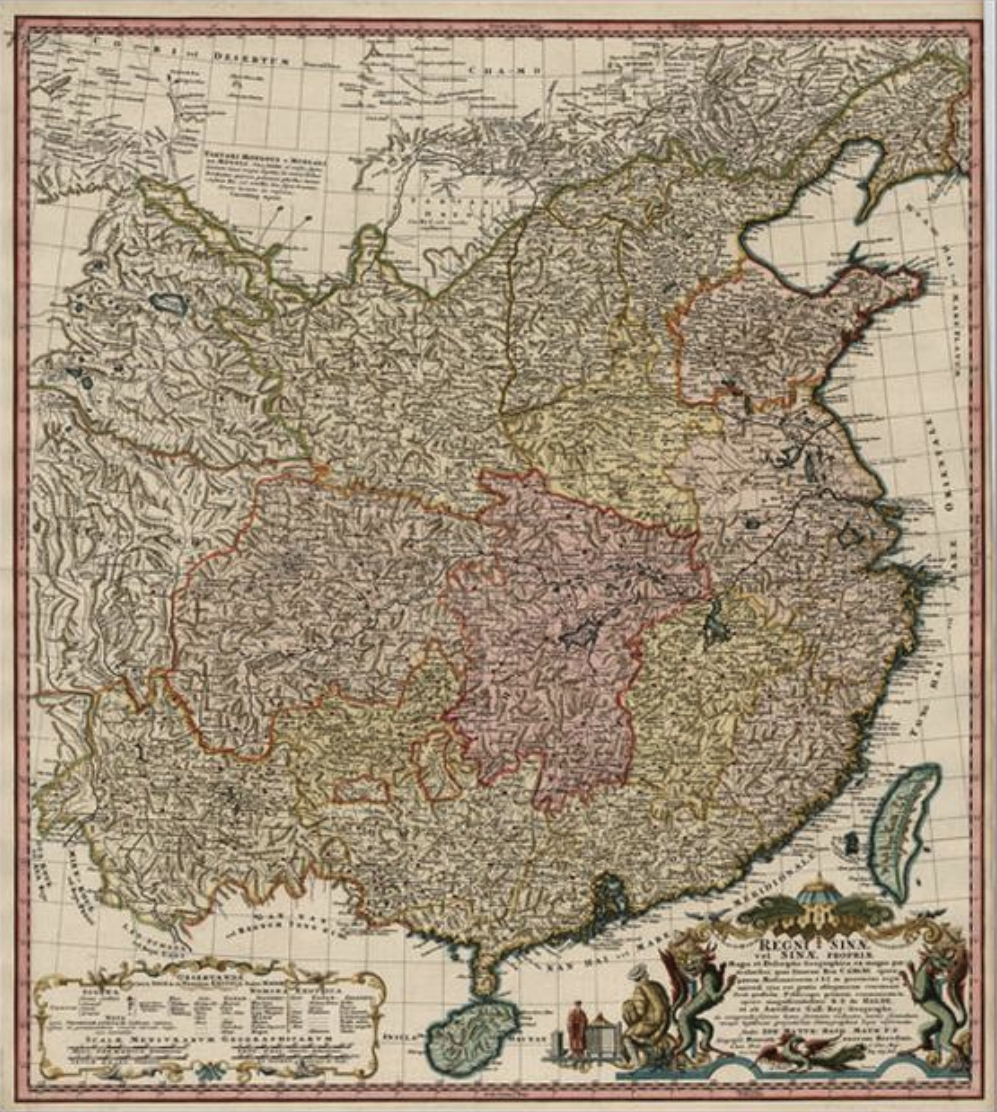
1740 German Map of Qing China
The map below was published in London, England, in 1844, depicting China and Japan. In the maps of Qing China created by Europeans, the interior and the peripheral regions are often marked in different colors.
We can see that the ‘interior’ roughly corresponds to the ‘China’ in terms of cultural geography, while the entire territory of the Qing Empire represents the political entity of ‘China’.
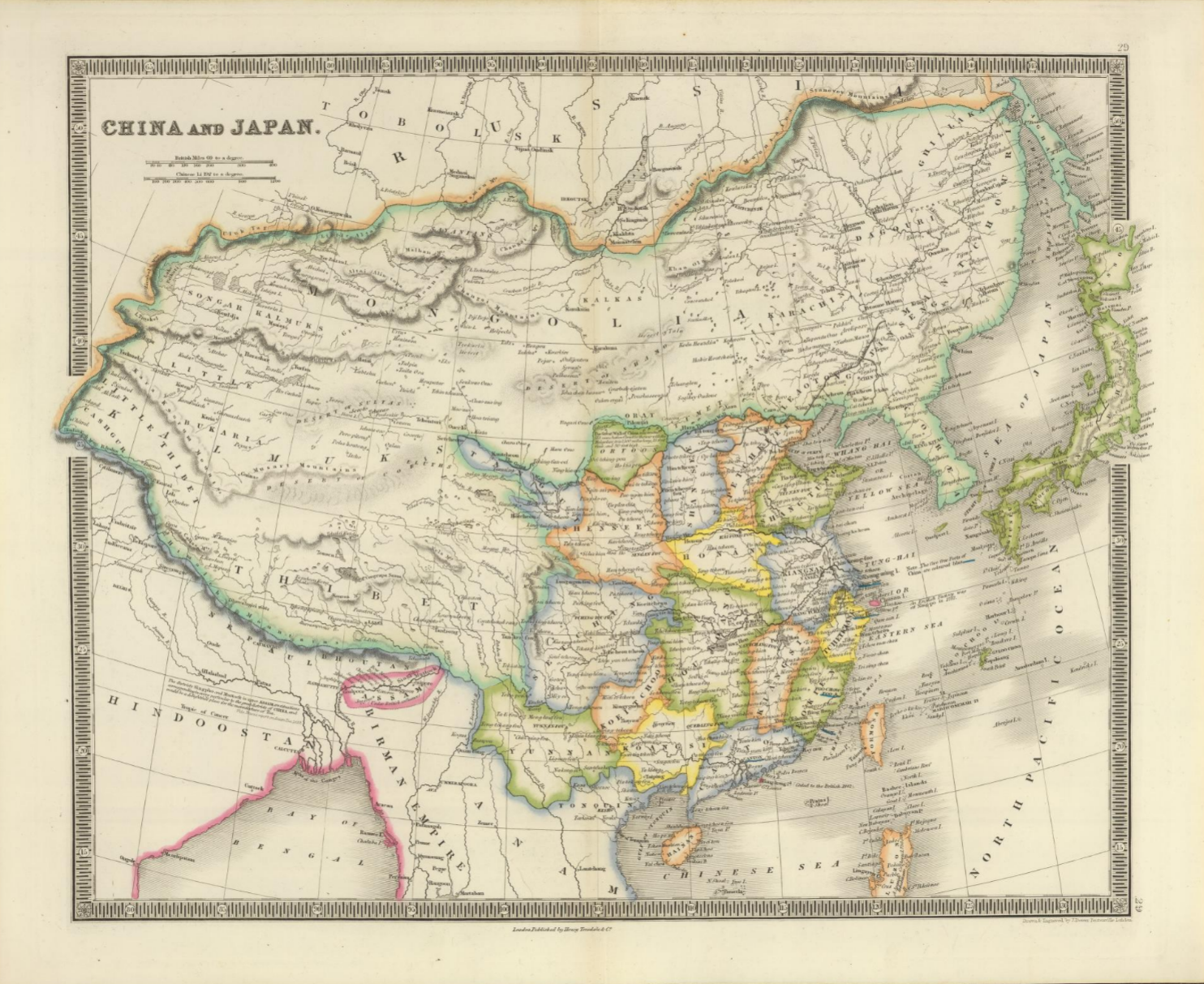
1844 Map of China and Japan
A further map clearly labels “China,” the “Chinese Empire,” and “Chinese Tartary,” corresponding to the cultural-geographical “China,” the political state “Chinese Empire,” and the imperial dependencies.
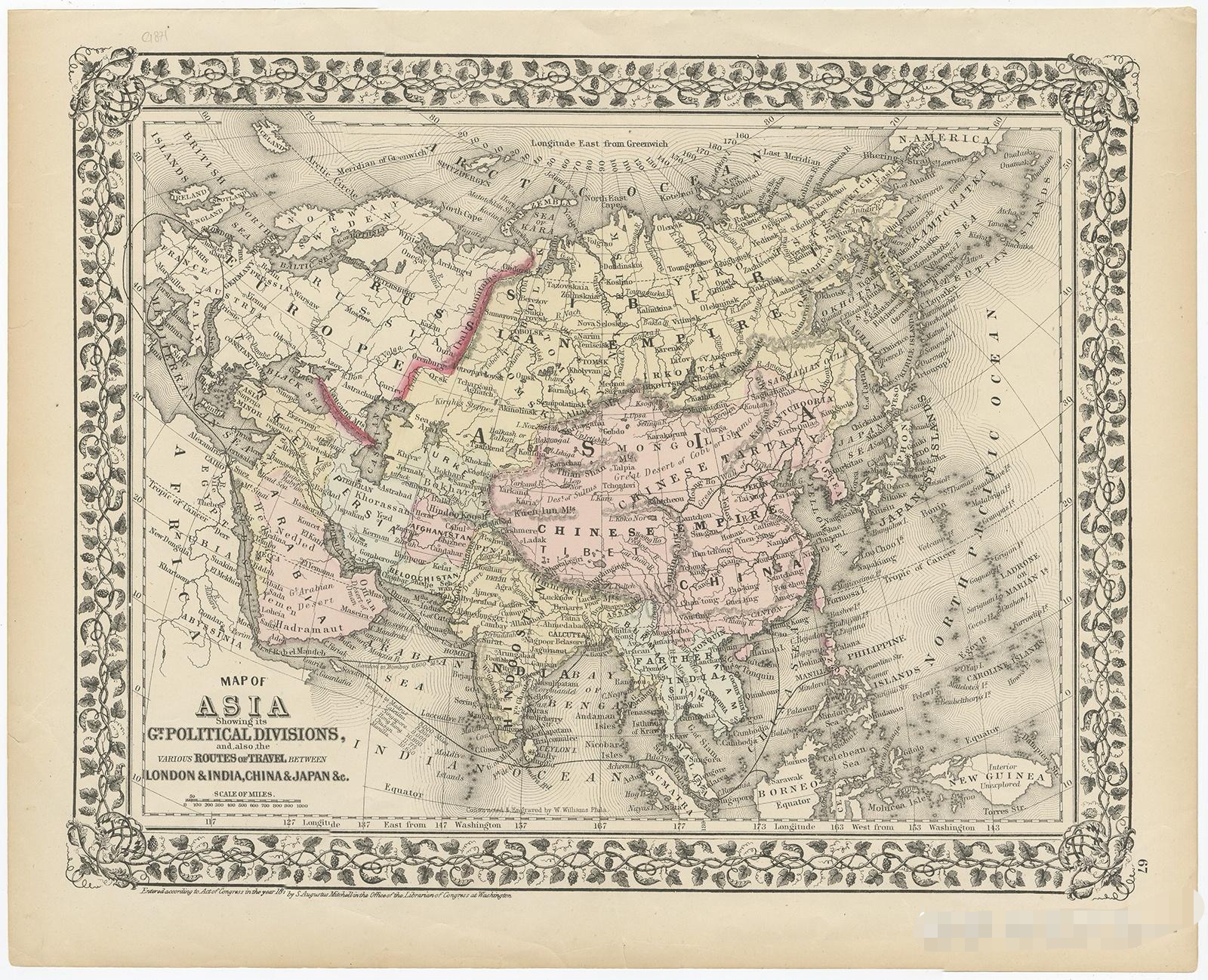
Unattributed Asia Map Including the Qing Empire
The Qing Empire’s territorial boundaries evolved significantly, reflecting the expansion and contraction of imperial power. However, one point is clear: territorial borders are dynamic and subject to change, not immutable or fixed throughout history.
Multiple Political Entities Within One Cultural Geography
Political fragmentation does not necessarily imply cultural disunity. Multiple political entities can coexist within the same cultural-geographical framework, sharing a unified cultural identity.
For example:
- During the Spring and Autumn Period, competing states maintained cultural unity through Confucian norms.
- The Three Kingdoms Period featured political division but cultural continuity based on Han traditions.
- During the Southern and Northern Dynasties, northern nomadic and southern Han-led regimes upheld a shared cultural foundation.
- The Five Dynasties and Ten Kingdoms saw severe political fragmentation, yet all regimes were rooted in Tang Dynasty cultural norms.
In modern times, “China” as a cultural concept extends beyond a single political entity. Overseas Chinese communities, for instance, identify with Chinese culture without necessarily aligning politically with the People’s Republic of China. Regions like Hong Kong, Taiwan, and Southeast Asia maintain cultural ties to “China” while being politically distinct.
Strictly equating “One China” with a single political entity overlooks the diversity and richness of Chinese culture. Viewed through a cultural-geographical lens, “One China” can accommodate multiple political entities while preserving cultural unity.
Conclusion
“China” serves as both a cultural-geographical identity and a political nation-state. Recognizing “One China” as a cultural framework enriches discussions about diversity and unity. Understanding “China” as a broader cultural-geographical concept deepens our appreciation of its complexity, offering new perspectives on nationhood, culture, and history.